Climate Change · Part II
The search for clean energy
Short on time? The 18-slide summary
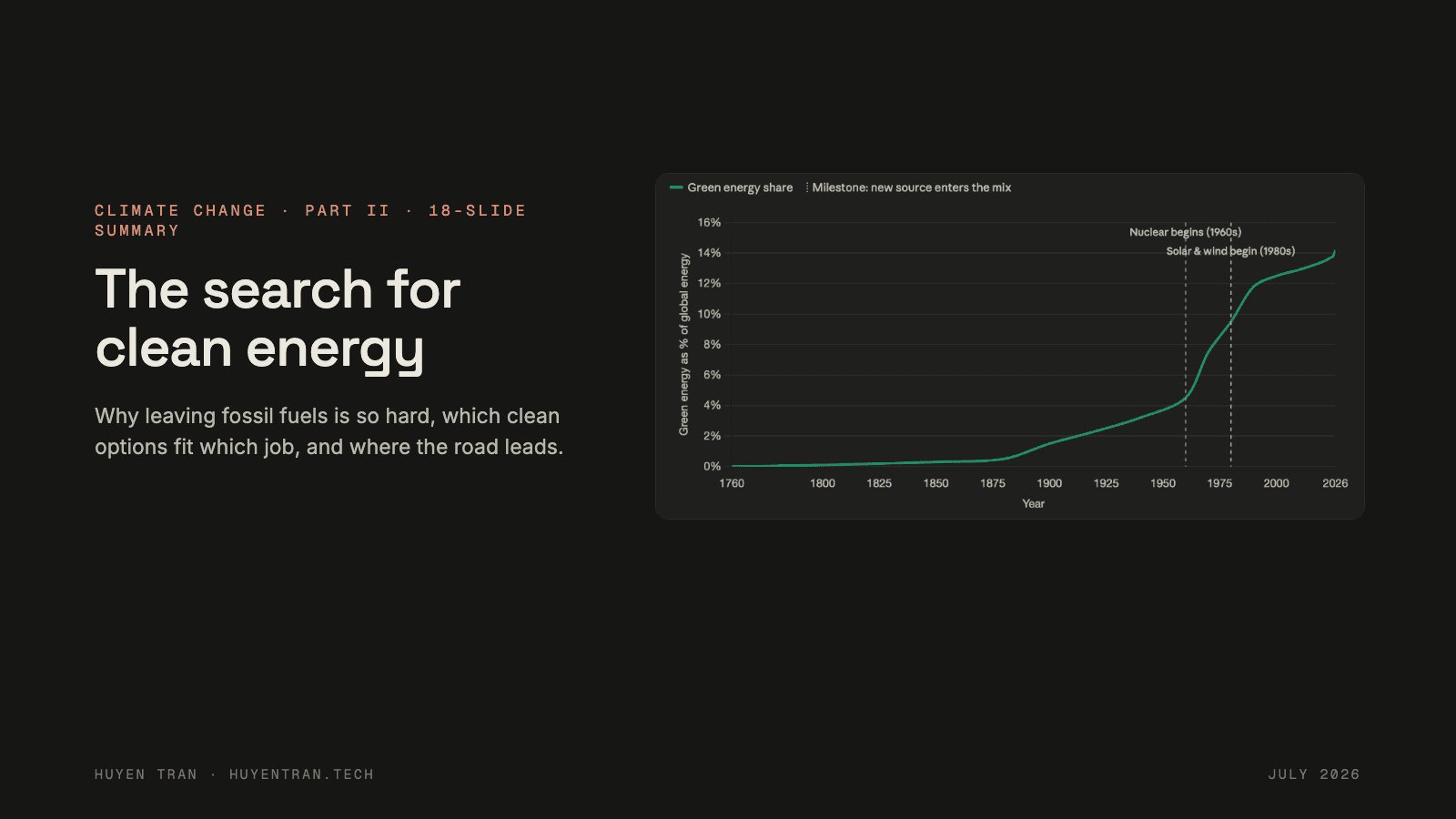
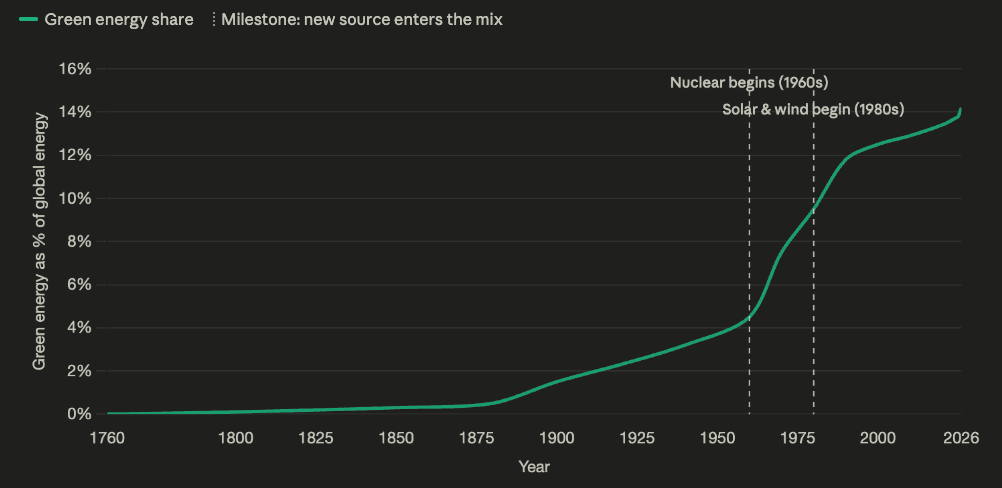
Figure 1. Clean-energy share of global primary energy, 1760 → today. Two hundred and sixty years since the Industrial Revolution, about 14% so far. This is what “we’re making progress” actually looks like.
I find this part of the essay very exciting to write about, but also more challenging than the previous part. It is exciting because I would love to be optimistic about our future. If putting together the problem requires acquiring important data and connecting different pieces of the puzzle together into the big picture, thinking about the solution requires the same skills, but also another important factor: an unlimited capability to dream. The scale of the solution will usually match the scale of the problem, and sometimes even surpass it — meaning it must be so fundamental that it can change human civilisation just like the problem did, and that is no easy feat. In this part of the essay, I will do my best to put everything together: data, logic, and some ambitious imagination, to envision a picture of the world that we can be excited about.
1.Our progress
From the previous essay, we have learned how dangerous and damaging greenhouse gases can be to our climate and how much of a threat they are to our civilisation. And if you are as alarmed as me, you probably already realise that we have to stop putting greenhouse gases into the atmosphere as fast as possible. So the obvious thing to do is to search for alternative energy — clean energy. Despite our efforts though, the picture still looks stark, though the pace is accelerating.
For the entire span from the Industrial Revolution’s start in 1760 until now, we have so far managed to switch around 13.8% of global energy usage to clean energy in 2025.[1]
- 1760–1900 — coal was the main energy of this era; its share of global energy grew from 1.7% in 1800 to 47.2% by 1900.[2]
- 1880–1900 — hydropower: the first hydroelectric plants came online around this time.
- 1960s — nuclear energy, the first clean energy source added in nearly a century.
- 1980s — solar and wind, the modern renewables. For decades after this they remained a rounding error in total energy usage.[3]
- 2000–2010 — renewables grew by just 1.1 percentage points globally in a full decade.
- 2010–2020 — that pace more than tripled, growing 3.5 percentage points in the following decade.
- 2020–now — roughly 13.8% of all global primary energy (electricity, transport, heating, industry combined) comes from nuclear, hydro, and modern renewables together.
That gap between the two numbers is exactly why the story is worth rewinding: to understand how deeply fossil fuels are woven into the harder-to-decarbonise parts of our economy — transport, heating, industry — we need to trace how energy became so central to civilisation’s development in the first place.
2.History of energy and human civilisation
What energy is
First things first — what is energy? Energy is the capacity of a system to do work — to exert a force over a distance, move mass, break or form a bond, raise a temperature, and so on.
The forms that energy can take:
- Kinetic — energy of motion.
- Potential — stored energy from position or configuration: gravitational (water behind a dam), elastic (a compressed spring), chemical (bonds between atoms, released when you burn wood or digest a meal), nuclear (binding energy inside an atomic nucleus).
- Thermal — the aggregate kinetic energy of countless jittering atoms; what we experience as heat.
- Electromagnetic — energy carried by light and other radiation.
- Electrical — energy of organised, moving electric charge.
- Mass itself — E = mc² shows mass is a form of stored energy. That’s why nuclear reactions release so much from so little fuel: a tiny amount of mass converts directly into an enormous amount of energy.
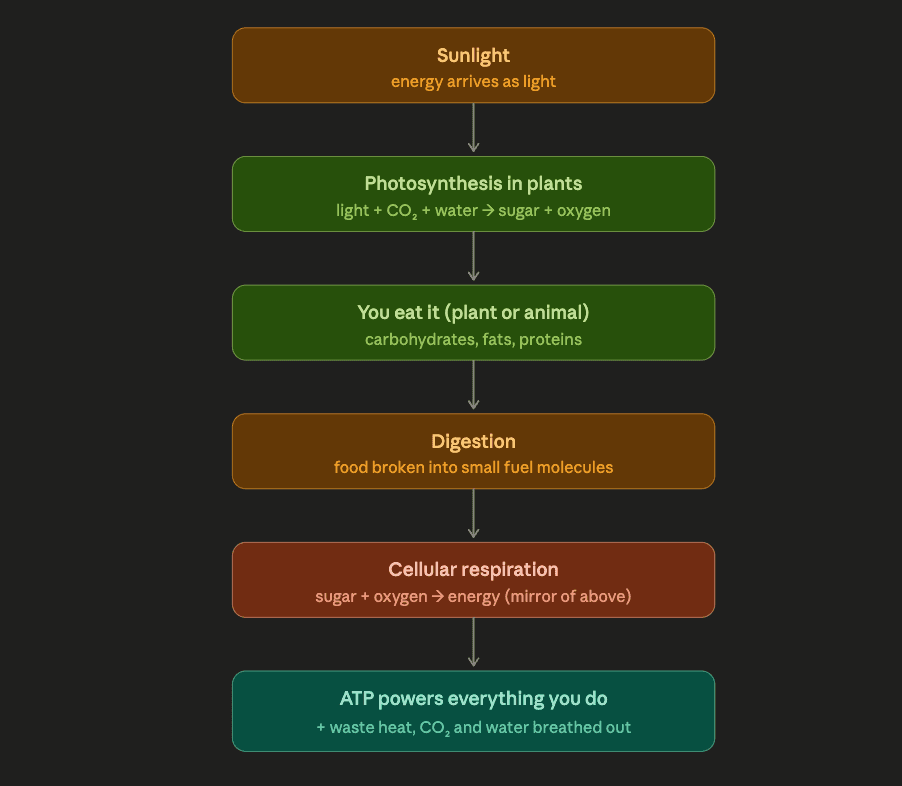
At the most basic physical level, each human is a small, highly organised, low-entropy pocket of matter that exists only because we are constantly importing usable energy (food, oxygen) and exporting waste heat and disorder to our surroundings. If you are interested in the details of the process, you can see more from the chart below.
From muscle to fossil fuels
The interesting thing is that, as living organisms, energy has always been fundamental for our existence. However, for most of human history we were solar-powered — taking energy indirectly from the sun through the food we eat. Then our discoveries and usage of energy started to evolve.
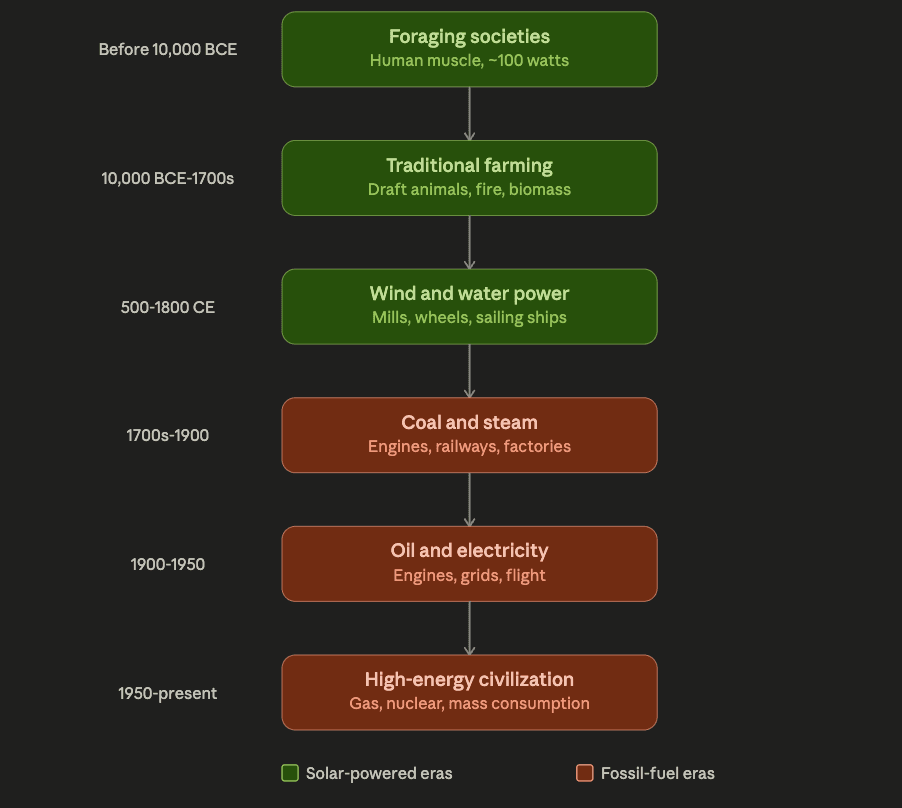
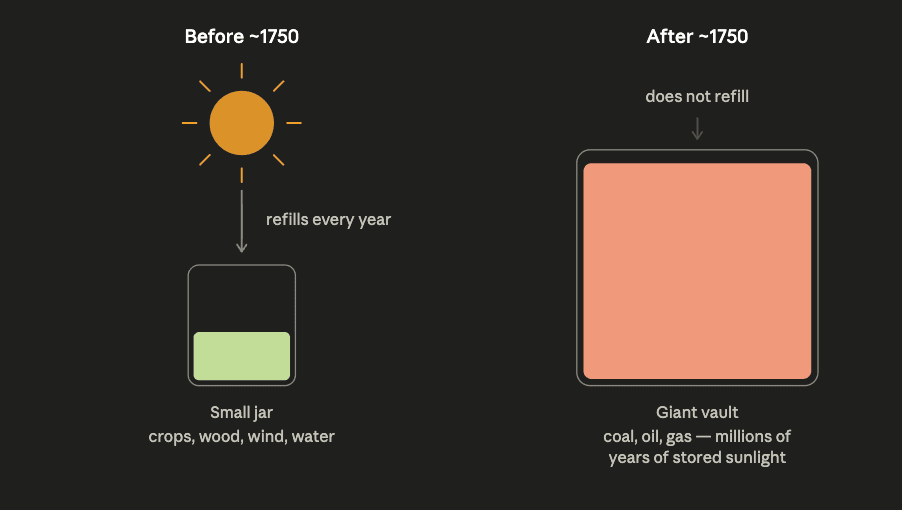
- For most of our history, people had only their own muscles (roughly 100 watts continuous — about one light-bulb),[6] plus, once fire was controlled several hundred thousand years ago, warmth, protection, and cooked food, which let us extract more calories from the same ingredients.
- Agriculture, starting around 12,000 years ago, was really a way of domesticating solar energy — cultivating plants captured sunlight far more reliably than foraging, and draft animals converted that captured energy into directed mechanical work.
- Wind and water mills added more mechanical energy in pre-industrial societies, but total capacity was still capped by available land, animals and weather.
- A breakthrough in energy captured happened in the Industrial Revolution: together with the process of outsourcing mechanical work from human and animal muscle to machine, humans started using fossil fuels to power those machines. Coal, then oil and gas, let people tap millions of years of stored sunlight all at once (fossil fuels were created by plants and micro-organisms, with a large part during the Carboniferous period 360 to 286 million years ago and the Mesozoic Era 252 to 66 million years ago).
- These dense, intensive amounts of energy we release all at once led to the fastest rise in human population, wealth, and technological capability our species has ever seen, and enabled the building of our modern civilisation.
- Electricity, from the late 1800s, added something fossil fuel alone couldn’t: a flexible, instantly controllable, transportable energy carrier — generated from many sources and delivered almost anywhere through a grid.
- Nuclear fission, in the mid-20th century, opened a source with energy density orders of magnitude beyond any chemical reaction.
Why demand kept climbing
Learning to capture more energy is one thing; needing to is another. A water-mill could grind more grain than any person ever could, but for most of history the total energy a society commanded stayed hemmed in by how much land, muscle and weather it could muster. What changed with fossil fuels was not only the amount of energy suddenly available, but the fact that our demand for it began to climb with no natural ceiling in sight (Jevons Paradox).[8] That climb came from two directions at once — and the reason it grew so steep is that the two multiplied together.
The first is simply that there came to be far more of us. For almost the entire span of human civilisation — 12,000 years that saw farming begin, then cities, empires and cathedrals rise — the world’s population crept upward so slowly that it looks flat on a chart. Then, just as coal and steam arrived, it turned more vertical: from one billion people in 1800 to roughly eight billion today, an eightfold rise packed into two centuries after barely moving in all the time before.[9]


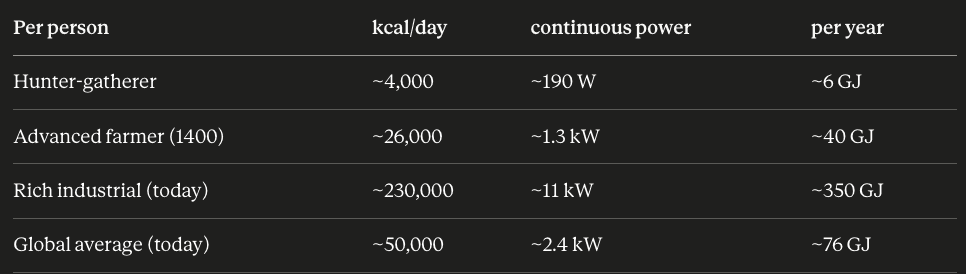
The second, and more dramatic, is that each of us came to draw far more energy than our ancestors ever did. A hunter-gatherer got by on something like four thousand kilocalories per day, almost all of it food and firewood. A person in a wealthy industrial society today commands well over two hundred thousand — roughly sixty times as much (Earl Cook, 1971;[10] later extended by Ian Morris[11]).


This is the quiet logic of progress: nearly every advance we call a convenience is a decision to have energy for a machine do work a body used to do, or work no body ever could. We plough with engines instead of oxen, travel by train and plane instead of on foot, compute in server farms instead of in our heads. And a modern life rests on vast shared systems that simpler societies never had to power at all — the steel and cement our cities are built from, refrigerated food that crosses the world, clean water, hospitals, the internet, and the data centres now humming behind everything digital.
Put the two together and we have the whole picture, because total energy demand equals the number of people multiplied by the energy each one uses. Multiply two curves that are each shooting up and the product is exponential. That’s why humanity’s total energy use exploded within a few generations after scarcely changing for most of our history.
3.Our addiction to fossil fuel
So far, we have seen how tightly our invention of the machine and our use of fossil fuels have been bound together since the Industrial Revolution. Because of that, certain of our largest industries and parts of modern civilisation have been not merely powered by fossil fuels but built and designed around them — engineered, from the foundations up, to exploit the particular things that coal, oil and gas happen to do so well.
To understand why we can’t simply walk away, it helps to notice that fossil fuels don’t do one job for us but several very different ones. They are a store of dense, portable energy we can carry with us. They are a source of fierce, concentrated heat. They are a chemical raw material — the actual matter that some things are made out of. And they are always-ready fuel that sits at full charge until the instant we choose to light it. A sector can shed fossil fuels quickly only when the particular job it needs doing can be handed to something clean — and, just as importantly, only when that hand-off can be made far enough upstream that the rest of the system barely notices.
Why upstream matters
“Upstream” is the hinge of the whole problem. Electricity is not really an energy source, it is a carrier. When we clean up the grid, we change what happens at a few thousand power stations, and every device downstream — the kettle, the tram, the factory motor — is decarbonised without knowing it, because a kilowatt-hour made by the wind is identical to one made by coal. Nobody has to buy anything or change a habit. But transport, heavy industry and heating don’t run on a carrier. They burn the fuel at the point of use, inside a billion separate engines, furnaces and boilers. There is no upstream to clean. To decarbonise them, we have to physically replace the end machine itself — which means persuading billions of separate owners each to buy a new, and at first costlier, device, and often it means inventing a device that can do the job at all.
The entire difference between the sectors that are moving and the sectors that are stuck comes down to this: how far upstream the substitution can be made, how few hands control it, and whether a clean machine that does the job even exists yet.
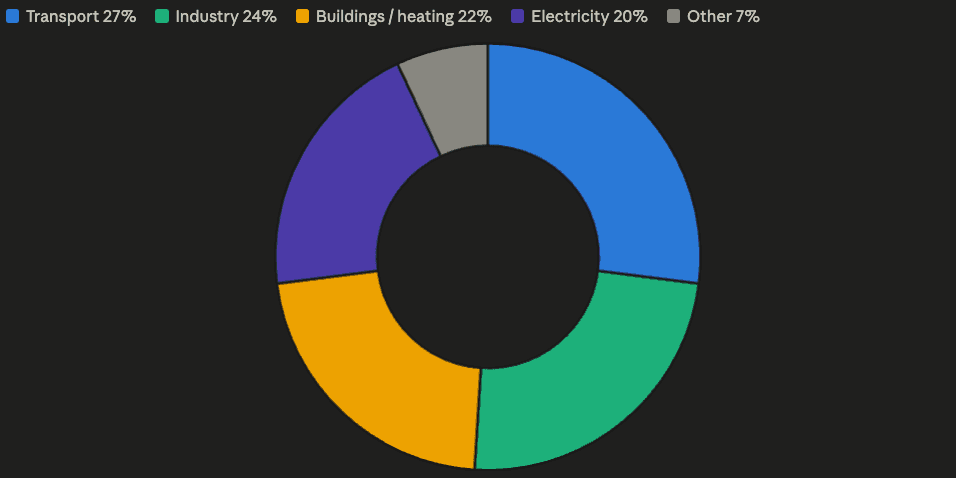
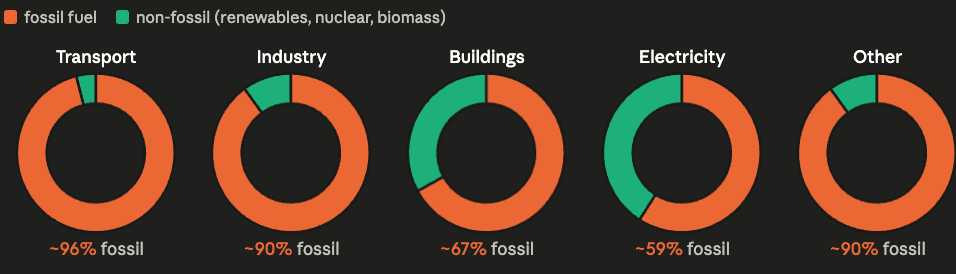
Where each sector stands
Regarding the progress:
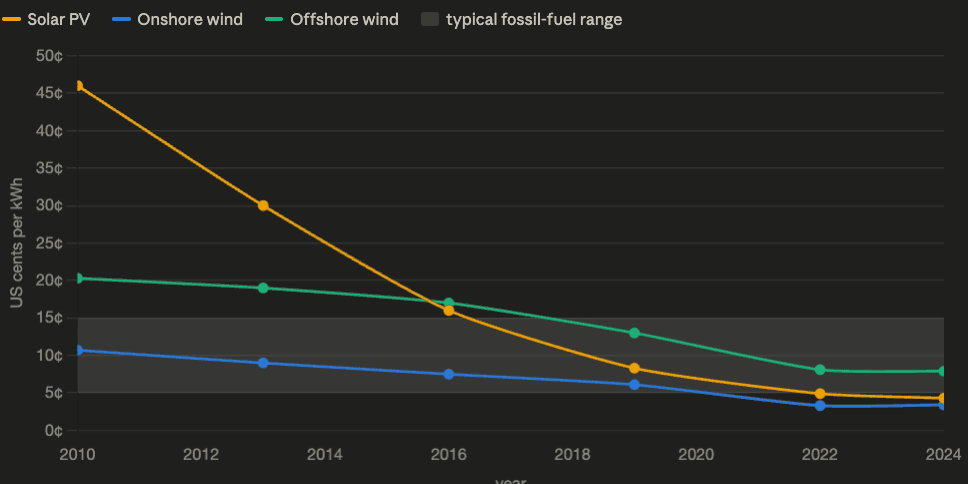
- Electricity is the sector that has moved the fastest of all. Its substitution happens entirely upstream, its product is perfectly interchangeable, and the cost of clean energy has fallen significantly with economies of scale in the past decades.[12]
- Buildings have moved relatively quickly too. The reason is that most of what a building needs is gentle, low-temperature warmth — heating rooms and water to sixty degrees or so — and that is the task heat pumps perform well, delivering three or four units of heat for every unit of electricity they draw,[13] and getting cleaner still as the grid behind them greens. Lighting and appliances are already electric.
- Transport is where the trouble begins, and it is really two problems wearing one name. Light transport — the ordinary car — is no longer physically hard. Batteries have quietly crossed the threshold, growing denser and cheaper until an electric car became, in many respects, the better machine. Which is why cars are the one part of transport that is genuinely moving: electric models passed a fifth of new-car sales worldwide in 2024 and reached about a quarter (25%) in 2025.[14] What holds them back now is not physics but sheer numbers — some 1.5 billion vehicles,[15] each individually owned and replaced only every fifteen or twenty years, and a charging network that has to be built alongside them. Heavy transport, though, runs into a hard wall of physics. A battery large enough to fly an aircraft across an ocean would weigh more than the aircraft could lift; the roughly fifty-fold energy-density advantage of liquid fuel,[16] so convenient elsewhere, becomes decisive here. Ships and planes therefore cannot simply be plugged in. They need drop-in liquid substitutes — synthetic e-fuels, sustainable aviation fuel, ammonia or methanol — which remain immature and expensive.
- Industry is the hardest case of all, and hard in the deepest way, because its dependence on fossil fuels is often not about energy but about chemistry and heat that electricity cannot easily supply. Cement kilns demand around 1,450 °C and steel furnaces around 1,600 °C[17] — temperatures a flame reaches cheaply and an electric process struggles to match without scrapping the entire plant. More fundamental still, fossil fuels here are frequently the raw material rather than the fuel. The coking coal in a blast furnace is not there mainly to make heat; it is the chemical agent that strips the oxygen from iron ore. The natural gas in fertiliser is the very source of the hydrogen atoms. Oil and gas are the molecular skeleton of every plastic. No quantity of clean electricity can stand in for a chemical ingredient — to remove the fossil fuel we must invent an entirely different process, and those processes, from hydrogen-made steel to green ammonia, are neither cheap nor proven, and must be built into plants that cost billions and run for forty years or more.
- Other — the rest of agriculture, fishing, construction and the machinery that works off the grid — is heavily fossil-fuelled because it quietly combines the two hardest problems. On one side it is diesel machinery in places with no wires: tractors, combines, irrigation pumps, trawlers, excavators, all of them remote, mobile and power-hungry. On the other side, it contains the fossil hydrocarbons we never burn at all — the bitumen in our roads, the lubricants in our engines, the waxes and solvents in a thousand products.
4.Alternatives to fossil fuel
If the task of finding alternatives to fossil fuels feels colossal — that’s because it is. The coming generations will have to redesign modern civilisation almost from the ground up, and if that feels overwhelming, you are not alone. But there are two reasons for hope.
The first is that history rewards the people who build an era’s energy system more richly than almost anyone else alive. The architects of the fossil age became the titans of their time: John D. Rockefeller, who organised oil, is by most inflation-adjusted measures still the wealthiest man in modern history;[18] Andrew Carnegie turned steel into one of the great fortunes; Henry Ford made an empire of the petrol car; and Fritz Haber and Carl Bosch, who learned to pull fertiliser from thin air, won Nobel Prizes and changed how the entire planet feeds itself. These were not simple heroes — Haber also fathered chemical warfare, and the oil and steel barons were ruthless men — but the pattern is unmistakable: whoever builds the machinery of a civilisation is rewarded on a scale almost nothing else can match, in wealth and in legacy alike. Building the next civilisation — the clean one — is an opportunity of exactly that size, and it is wide open.
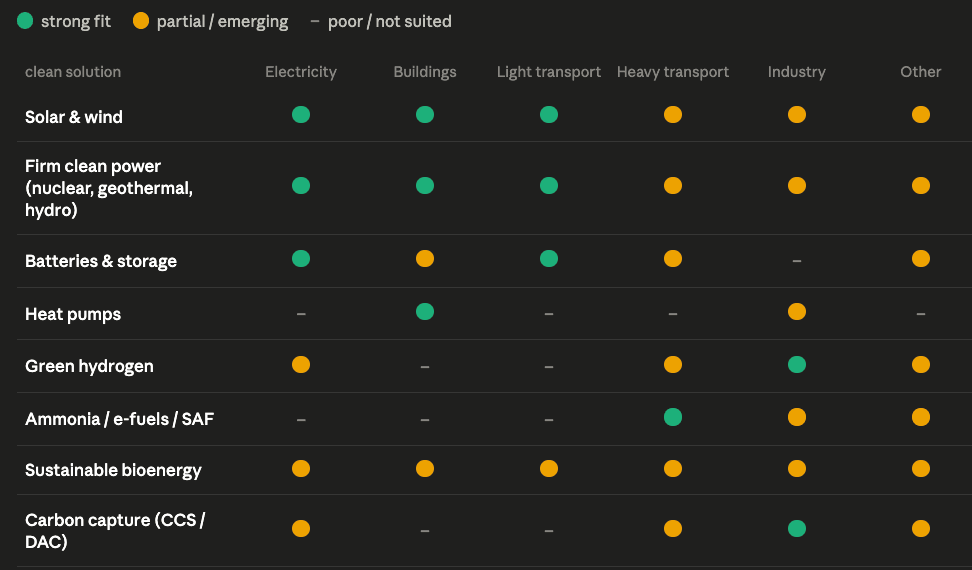
The second reason is that we are already making good progress. Let’s go through all the clean-energy options we have now and see how they fit each sector.
The efficiency ladder
Before getting into the details, one rule makes sense of everything that follows. The clean options don’t sit on a flat menu; they fall into a strict order of preferences — an efficiency ladder — set by a single fact of physics: every time we convert energy from one form to another, we waste some of it. So the best choice is always to use clean electricity as directly as possible: sun or wind, to a wire, to a motor or a warmed room, with almost nothing lost. Where we can’t wire it straight in, the next logical thing to do is to store that electricity in a battery. And only when neither will do, do we drop to the lowest option — turning electricity into a fuel we can carry and burn, which throws away more than half of what we began with. Direct electricity, then batteries, then fuels. How far down that ladder each sector is forced to reach is exactly what decides how hard it is to go clean.
- Electricity — essentially solved; a deployment and storage problem, not an invention problem. (1) Solar and wind as the cheap bulk backbone; (2) firm clean power — nuclear, geothermal, hydro — as the always-on complement that covers windless, sunless hours; (3) batteries and long-duration storage to smooth the rest. The sector sits squarely on the first step of the ladder, which is why it is the front-runner: the technology exists, it is the cheapest option, and the only real work left is building fast enough and solving the last 10–20% of “firming” that variable renewables can’t cover alone.
- Buildings — solved in the lab, gated by the renovation rate. (1) Heat pumps, running on the greening grid, do the central job — gentle heat — at three-to-four-hundred-per-cent efficiency (they move heat rather than make it, delivering three or four units for every unit of electricity they draw); (2) clean electricity handles everything else, since lighting and appliances are already electric; (3) district heating, solar-thermal and direct geothermal in the right places. The only real barrier is pace: buildings last a century, so this is about swapping a few hundred million boilers, not about any missing device.
- Light transport — solved. (1) Batteries and EVs; (2) biofuels as a fading transitional blend. The battery quietly became good enough that an electric car is now, in many respects, the better machine — which is why roughly a fifth of all new cars sold worldwide are already electric. What holds it back is not physics but fleet turnover and the charging network being built alongside it.
- Heavy transport — genuinely unsolved, and where it goes all the way to the lowest level of the energy ladder. There is no single winner; the answer splits by mode. For long-haul trucks, batteries are climbing further than expected (short and medium haul first), with hydrogen fuel cells second. For shipping, the leaders are green ammonia and methanol, with batteries only for short ferries and wind-assist as a helper. For aviation, sustainable aviation fuel and e-kerosene lead because they are drop-in liquids that existing engines and airports already accept, with hydrogen a long-term redesign and batteries viable only for short regional hops. The unifying reason is the fifty-fold energy-density gap: these machines must carry a dense fuel, so they are forced down the ladder to expensive, immature molecules.
- Industry — the hardest, and it needs a range of solutions, not one-size-fits-all. For high-temperature heat, electrification (arc, induction, plasma) where the plant can be rebuilt, with nuclear and geothermal process heat emerging. For steel, green-hydrogen direct reduction is the leading route, plus electric arc furnaces for recycled scrap. For ammonia and chemicals, green hydrogen as feedstock — the single clearest, most bankable hydrogen use, and where surviving projects are concentrating. For cement, there is no way to electrify away the CO₂ that comes from the limestone itself, so carbon capture is not optional — it is, so far, the only tool for that chemistry.
- Other — for off-grid machinery (tractors, trawlers, excavators), the solution is batteries where the duty cycle allows, then drop-in biofuels and renewable diesel, then hydrogen — essentially the heavy-transport solution at smaller scale. For the fossil hydrocarbons we never burn (bitumen, lubricants, plastics feedstock), the answers are bio-based feedstocks, recycling and circularity, and capturing the residue.
Where I stand
Geothermal is especially interesting to me. The heat is effectively limitless — fiercer the deeper you drill — and, unusually, much of the groundwork is already laid: the drilling rigs, the talent and the supply chains can be readily reused from the oil and gas industry, which lowers both the cost and the human friction of the switch.[19] The one real caveat is that the deep-drilling technology needed to make it scalable everywhere is still maturing.
The rest is more personal — my own sense of which trade-offs sit well with me and which don’t.
Among the storage options, I’m quite excited about sodium batteries as an alternative to lithium, since they sidestep the pollution and scarcity of lithium mining, at the modest cost of a little energy density.
A few I hold at arm’s length for now. I’m cautious about nuclear: in fairness, its waste is small in volume and safely contained rather than dumped into our shared air, permanent geological repositories (Finland’s Onkalo, the world’s first) are at last coming into operation,[20] and per unit of energy it is among the safest sources we have[21] — yet the sheer longevity of that radioactive waste (up to hundreds of thousands of years) still gives me pause, and I’d rather watch those solutions mature before I fully embrace it. Large hydro, too, I would use sparingly, since damming a river can badly disrupt its ecosystem.
On carbon capture I want to draw a careful line. For the unavoidable chemistry of cement, where nothing else yet works, we might have to accept it as a necessary tool. But bolted onto fossil-fuel power stations it worries me — there it can become an excuse to keep burning — and I’d trust it far more in independent hands than in those of the fossil-fuel industry itself. And direct air capture I’m keeping in my back pocket: because CO₂ is so thinly spread through the atmosphere — barely 0.04% of the air — pulling it back out is still far too energy-hungry and costly to rely on today, though better technology may yet change that.
The road to hydrogen
Step back from the analysis and a clear pattern emerges. The sectors we can green easily are the ones that reach step one of the energy ladder — clean electricity, straight in. The stubborn ones — heavy transport and heavy industry — are forced to the bottom step, where no electric process could do the job and only a clean fuel will serve.
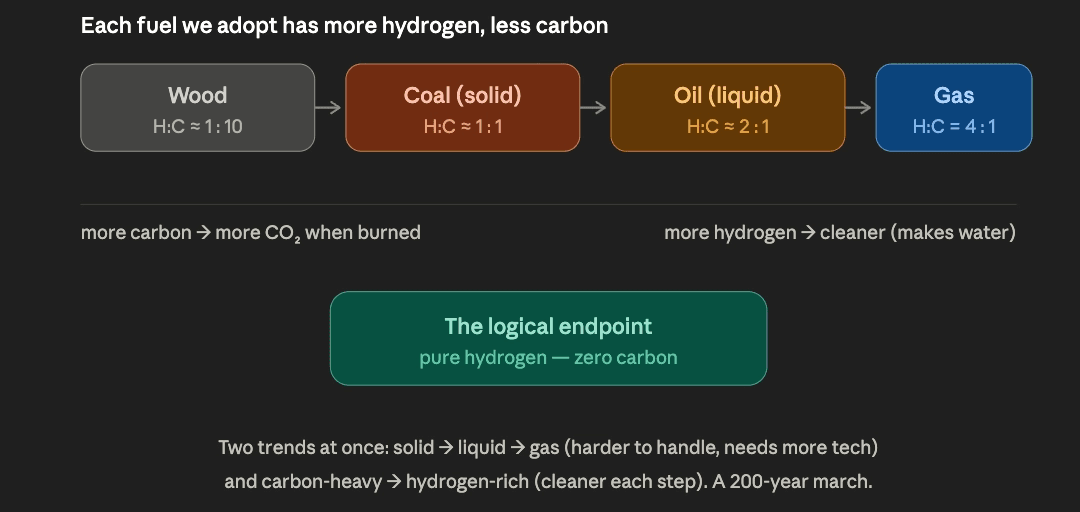
And here the older story — the long march of fuels from wood to coal to oil to gas — quietly tells us what that fuel must be. At every step of the march, the fuel shed carbon and gained hydrogen, growing cleaner as it grew richer in the one element that burns to nothing but water. We have been drifting toward hydrogen for two hundred years without ever naming it[22] — a trajectory first identified by Cesare Marchetti in the 1980s and developed as decarbonisation by Jesse Ausubel at Rockefeller.[23] Pure hydrogen is simply the end of that road: a fuel that is all hydrogen and no carbon at all, that burns to leave behind only water — though today less than 1% of the ~100 Mt of hydrogen we already produce each year is made from low-emissions sources.[24]
References
- Our World in Data. Global primary energy consumption by source (1800 → present; underlying dataset: Vaclav Smil + Energy Institute Statistical Review of World Energy). ourworldindata.org/grapher/global-energy-substitution. Cross-check on the ~13.8% figure: OWID Renewable Energy, ourworldindata.org/renewable-energy.
- Our World in Data. Global primary energy consumption by source — coal share of global primary energy, 1800 → 1900. ourworldindata.org/grapher/global-energy-substitution
- Our World in Data. Energy Mix(Ritchie, Rosado & Roser) — references Smil on the slowness of past energy transitions; notes nuclear was added in the 1960s and modern renewables (solar / wind) only in the 1980s. ourworldindata.org/energy-mix
- Ember. Global Electricity Review 2026 — clean power reached ~43% of global electricity in 2025; renewables overtook coal for the first time in over a century. ember-energy.org/…/global-electricity-review-2026. 2024 milestone (40.9% low-carbon, first time above 40% since the 1940s): Global Electricity Review 2025, ember-energy.org/…/global-electricity-review-2025.
- Ember. European Electricity Review 2026 — EU renewables 47.7% in 2025; wind + solar (30%) overtook fossil fuels (29%) in the EU for the first time. ember-energy.org/…/european-electricity-review-2026
- Vaclav Smil. Energy and Civilization: A History. MIT Press, 2017 — the standard reference for prime movers, the ~100 W human, the muscle → machine transition, and the “additions, not transitions” framing.
- Vaclav Smil. How the World Really Works. Viking, 2022 — the “four pillars of modern civilisation” framing (steel, cement, ammonia / fertiliser, plastics).
- William Stanley Jevons. The Coal Question: An Inquiry Concerning the Progress of the Nation, and the Probable Exhaustion of Our Coal-Mines. Macmillan, 1865, Ch. VII — the original formulation of what is now called Jevons Paradox. econlib.org (Library of Economics)
- Our World in Data. Population Growth — the flat-then-vertical 1 billion (1800) → 8 billion (today) curve. ourworldindata.org/population-growth
- Earl Cook. The Flow of Energy in an Industrial Society. Scientific American 225(3), September 1971, pp. 134–147 — the canonical ~4,000 → ~230,000 kcal / person / day arc across foraging, farming and industrial societies. scientificamerican.com
- Ian Morris. Foragers, Farmers, and Fossil Fuels: How Human Values Evolve. Princeton University Press, 2015 — extends Cook’s per-capita energy-capture method into a long-run index. See also Morris, The Measure of Civilization (Princeton, 2013).
- IRENA. Renewable Power Generation Costs in 2024 (published July 2025) — utility-scale solar PV LCOE down ~90% since 2010 (to $0.043/kWh); solar 41% cheaper and onshore wind 53% cheaper than the cheapest fossil alternative; 91% of new utility-scale renewables in 2024 undercut the cheapest new fossil option; battery storage down 93% since 2010 to $192/kWh. irena.org (PDF)
- IEA. The Future of Heat Pumps — heat pumps deliver 3–5× the useful heat per unit of energy compared with gas boilers; typical household COP ≈ 4. iea.org/reports/the-future-of-heat-pumps (see also the illustrated how a heat pump works page).
- IEA. Global EV Outlook 2026, Executive Summary — 25% of new cars sold worldwide in 2025 were electric (>20 million); in China EVs passed half of all car sales. iea.org/reports/global-ev-outlook-2026. 2024 baseline (17 M+ sold, >20% share): Global EV Outlook 2025, iea.org/…/global-ev-outlook-2025.
- OICA (International Organization of Motor Vehicle Manufacturers). Vehicles in use, by country and region — 2024 survey, 2025 — the canonical count of the world vehicle fleet (~1.5 billion). oica.net (PDF)
- US Department of Energy — Alternative Fuels Data Center. Fuel Properties Comparison — gasoline ~46 MJ/kg (~12.8 kWh/kg), aviation kerosene similar; lithium-ion battery packs ~0.7–1.0 MJ/kg (~0.2–0.25 kWh/kg), giving liquid fuels a ~40–60× energy-density advantage. afdc.energy.gov (Fuel Properties PDF). Battery pack side cross-checked against Wikipedia — Energy density (well cited to primary engineering sources).
- Cement kiln temperature (~1,450 °C, clinker formation): GCCA, Concrete Future — Roadmap to Net Zero, 2021. gccassociation.org (PDF). Steel blast-furnace temperature (~1,500–1,600 °C): IEA, Iron and Steel Technology Roadmap, 2020. iea.org/reports/iron-and-steel-technology-roadmap
- Guinness World Records. Richest person (ever) — adjusted for inflation (updated 2024). John D. Rockefeller ranks first by the economic-share method (~$631 billion in 2024 dollars). Note: the ranking flips under CPI-only adjustment, so the essay hedges as “by most inflation-adjusted measures.” guinnessworldrecords.com
- Fervo Energy. Technology — describes how enhanced-geothermal development ports horizontal drilling and hydraulic-fracturing techniques, rigs, and crews directly from the oil and gas industry. fervoenergy.com/technology. Workforce-transfer angle: Elemental Impact, Drilling for Jobs: How Fervo Energy is Building the Workforce, 2024, elementalimpact.com.
- IAEA. Finland’s Spent Fuel Repository a “Game Changer” for the Nuclear Industry, Director General Grossi Says, 2023 — on Onkalo, the world’s first permanent deep geological repository for spent nuclear fuel, coming into operation. iaea.org/newscenter/…/finlands-spent-fuel-repository. Operator primary source: Posiva Oy, posiva.fi.
- Our World in Data. What are the safest and cleanest sources of energy? — death rates per TWh: coal ~24.6, oil ~18.4, gas ~2.8, nuclear ~0.03, solar ~0.02, wind ~0.04. Nuclear causes roughly 99.8% fewer deaths than coal. ourworldindata.org/safest-sources-of-energy
- Cesare Marchetti. Nuclear plants and nuclear niches. Nuclear Science and Engineering 90 (1985): 521–526 — the primary source that first framed the wood → coal → oil → gas → hydrogen trajectory as “decarbonisation.”
- Jesse H. Ausubel. Decarbonization: The Next 100 Years — “the inverse of decarbonization is the ascendancy of hydrogen.” Program for the Human Environment, Rockefeller University, 2003. phe.rockefeller.edu (Decarbonization). See also Ausubel, Can Technology Spare the Earth? for the H:C ratios (wood 0.1, coal 1, oil 2, gas 4).
- IEA. Global Hydrogen Review 2025, Executive Summary — hydrogen demand ~100 Mt in 2024; low-emissions hydrogen still under 1% of global production; 2030 outlook cut from 49 to 37 Mtpa on project delays. iea.org/reports/global-hydrogen-review-2025