Artificial Intelligence · Part I
From biological intelligence to artificial intelligence: a brain for hire
Short on time? The 8-slide summary
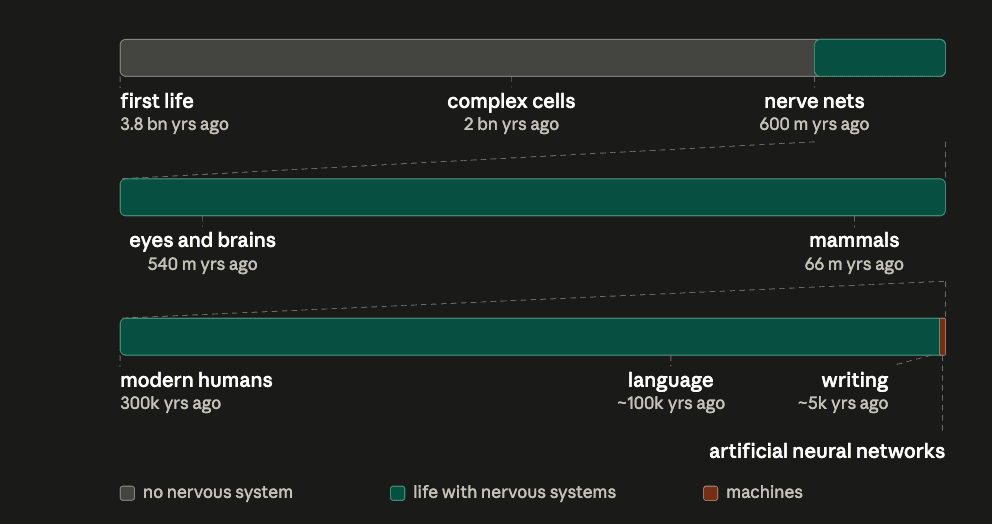
Figure 1. The whole arc of this essay on one line — from the first molecules that could copy themselves to artificial neural networks. Four billion years of building intelligence into bodies, and then, at the very end, one that doesn’t need a body at all.
1.Introduction
AI.
More than five years ago, before CODE, I had almost no clue what it was. At the time I worked for a company managing financial services for millions of users and small businesses in Vietnam — something like N26 for the Vietnamese market. I often hung out with people from the AI team, and what I understood was that they used machine learning to find patterns in historical data to predict user behaviour and prevent fraud. In late 2019, that was the state of the art.
Then CODE happened. In my application, besides solving a digital challenge, CODE asked: if there were no constraints at all, what kind of technology would you build? I wrote that I would build a product so smart that it could advise you on every decision in your life. It was a naive answer. The idea came from growing up seeing people who carry the weight of important decisions — kings and queens of the old days, governors and CEOs of the new ones — surround themselves with a board of advisors drawn from different domains. I always thought that was such a good concept. How much better would life be if we humans stopped making so many mistakes? Would it really be easier that way?
Fast forward a couple of years, and LLMs became a thing. The first time I used one, I thought: this is exactly the thing I have always been looking for. I thought it wasn’t possible, until it was. But is it really as magical as it was in my dream? Or is it the kind of technology that feels like magic in your hands while underneath it is messy and buggy — and it is human engineering that has worked so hard to make it as smooth and as powerful as it now is, like every other great technology we have ever built?
The only way to find out, I decided, was to work with it. To build with it. My first project was my Bachelor thesis on AI regulation, where I worked with a couple of engineers to build a RAG system so that an LLM could search through the law and advise developers and businesses on staying compliant. This was before RAG was built into chat products like GPT or Claude, back when the models still couldn’t read a PDF for you. The product was good: dozens of businesses and developers signed up for the trial, and we had a small launch on Product Hunt.
That was interesting. But I had only learned the outer layer of LLMs, nowhere near the core. After graduation I took a job at a geospatial data company and put the curiosity aside, keeping AI at arm’s length for nearly a year — until the company was acquired, my job ended, and I took a long break.
This time I didn’t feel like finding another job. I wanted to sit down and take my time to learn AI to the core: its beauty and its complexity, its seemingly magical capabilities and its shortcomings. During those months I also learned German from scratch, and biology — one for my long-term residency, one to take better care of my health. Neither felt connected to AI at the time.
German is an old and heavily grammatical kind of language. English I learnt pretty much through immersion. German, most of the time, I have to figure out the grammar before I speak. Every noun depends on case and gender, and I have to run through the rules until it lands on the right form. When learning it, I often broke the long words and sentences into pieces and guessed the meaning from the parts. I only realised later that this is more or less how a model learns language too: it breaks text into pieces, learns to predict what comes next, and the knowledge comes along with it.
Biology turned out to be the bigger lens. Learning how biological life and intelligence work gives me a fundamental understanding of how artificial intelligence was built in imitation of the biological one — where the two are similar, and where the differences start to show.
Those two, combined with the software engineering knowledge I picked up over years at CODE and in my product management job, turned out to be the golden trio — the foundation for going deeper into AI.
So this time I come back to it as an AI engineer, working from the top layer down to the core. My goal is to demystify this magical technology: to understand how it is built, what it can and cannot do, how it can be applied, and what skills the rising role of AI engineer actually demands — the people working hard to get the most out of it for production use cases.
2.From the earliest form of life to artificial intelligence
Well, first things first: what is AI really? AI means artificial intelligence. So if we want to understand AI, we have to understand intelligence. But what is intelligence? The easiest way I found to answer that is to look at how it arrived — the timeline at the top of this essay.
Life starts around 3.8 billion years ago with molecules that could copy themselves.[1] No cells, no metabolism we could recognise. Just chemistry that made more of itself and passed on its shape, imperfectly. The imperfection is the whole point. Copies that came out slightly wrong sometimes worked better, and those made more copies. So information is already here, written into the sequences.
Then around 2 billion years ago one cell swallowed another and didn’t digest it. The swallowed one stayed and kept working, and that is where mitochondria come from. It sounds like a small domestic incident. It was the thing that made everything after it affordable, because a cell with mitochondria generates energy on the inside instead of across its surface, so the energy budget grows together with the body.[2] Brains are expensive. Our brain is around two percent of our weight and burns around twenty percent of our energy.[3] Nothing that expensive could be bought before this.
But for a very long time in the history of life there was nothing that could be considered intelligence at all. Life was still simple.
And then around 600 million years ago, starting with nerve nets, intelligence starts to grow. First were diffuse meshes with no centre, the kind jellyfish still run on.[4] Poke one edge and the signal spreads. Nobody is in charge, but the cell already has sensing. Information in the system is still constrained within the physical body — it is just fast enough that a body made of many cells can act like one.
And then the Cambrian, the explosion of life. In a geologically short window of time, we get bodies with a front and a back, eyes that form images, and nerve tissue bunched at the front into something you would call a brain. There is a good argument it all arrived together: predators start to exist.[5] For survival, once you are being chased, the animal that sees it coming and guesses where it will be in two seconds outlives the one that reacts too late. So the nervous system stops being a relay that passes signals along and starts being a model that runs a little ahead of the world. And a model that predicts needs to remember, because the only thing you can guess from is what already happened. That is learning. And it is the first time the information of life has been stored anywhere other than in DNA.
Then, almost nothing happened for another half a billion years. Brains get bigger and better, slowly, one generation at a time, and every one of them still dies with the animal that grew it.
However, modern humans appear around 300,000 years ago,[6] and somewhere along the way, we started to invent languages. Speech carries what one person figured out into another person’s head. Writing, which arrived much later, carries it into another century and brings human knowledge across the planet. Knowledge stops being trapped in individual skulls and becomes a pool anyone can add to and anyone can also draw from. This is the first time in around 4 billion years that what a mind knows outlives the body that learned it. But the mind itself still doesn’t. Every step until now builds intelligence into a body, pays for it out of that body’s energy budget, and loses it when the body ceases to exist. Writing moves the knowledge out, but not the system that does the thinking.
And that leads to the last step so far. Since humans started working with tools, and later built machines, it has been our dream to replicate our intelligence in one — to make a mind that doesn’t need a body to live in. For the last eighty years we kept trying: build something loosely shaped like neurons, feed it examples, let it adjust itself until it gets them right. For decades it barely worked. What made it work in the end was the pool — all that written knowledge, digitised, at a scale no person could read in a thousand lifetimes, and enough computing power to learn from it. So a model learns language the way it learns everything else: by predicting what comes next, over and over, until the knowledge comes along with it. In four billion years, evolution never once separated a mind from the organism that owns it. This is the first thing that isn’t one.
3.The evolution of artificial intelligence — and how neural networks won
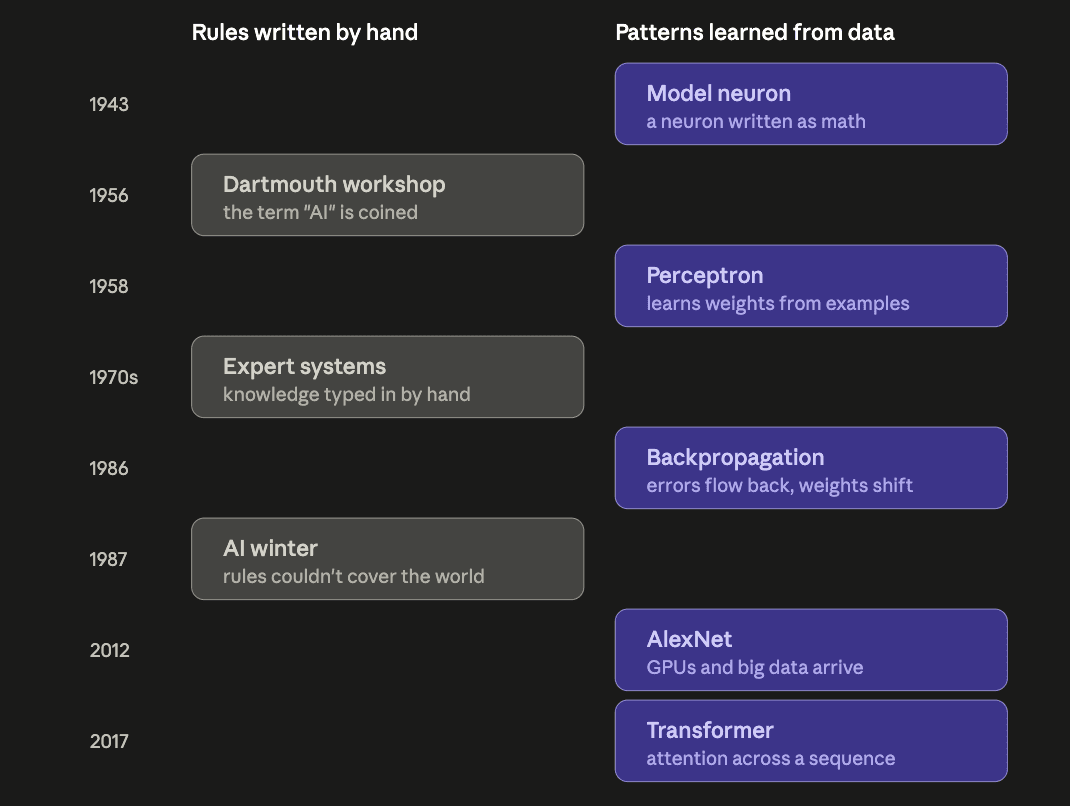
Since humans decided to build artificial intelligence, there have always been two bets running in parallel.
The first bet was that intelligence is a set of rules, and if you write enough of them down, you get a mind. This was the respectable position for thirty years. It is where the term “artificial intelligence” comes from — a workshop at Dartmouth in 1956[7] — and it produced expert systems, programs with thousands of hand-written rules for diagnosing an illness or configuring a machine. They worked, narrowly. Then they hit a wall so hard that the funding disappeared and people started calling it the AI winter.
The wall was this: most of what we do, we do without knowing how. Recognising a face. Telling an angry voice from a tired one. Nobody can write those down as rules, because nobody has the rules to begin with.
The second bet is actually the older one. Instead of writing the rules, build something that can find them itself. To see where that idea came from, you have to look at what a brain is made of.
A neuron is not complicated. It has branches that receive signals from other neurons, a body that adds those signals up, and a single wire out. If the incoming signals total past a threshold, it fires — sends a pulse down the wire to whatever it is connected to. If not, it stays quiet. Functionally, that is the whole cell. It adds, and it decides.
What makes it interesting is the connections. A neuron isn’t wired to a few others, it is wired to thousands, and the connections don’t carry equal weight. Some are strong — when that neuron fires, this one almost certainly fires too. Some are weak, barely a whisper. And those strengths change. Every time you learn something, some connections in your head get stronger and others get weaker. Not metaphorically. Physically. Your knowledge isn’t stored in any single cell. It is stored in the pattern of how strongly eighty-six billion of them are hooked to each other.[8]
In 1943, McCulloch and Pitts wrote that down in maths, thirteen years before the term artificial intelligence existed.[9] Numbers come in, you add them up, and if the total passes a threshold you output a one, otherwise a zero. Rosenblatt added the important half fifteen years later: give each input an adjustable weight, so a connection can be strong or weak, and let the machine set those weights itself instead of a person setting them.[10] That is an artificial neuron. It is a caricature of the real thing.
Then you stack them. A layer of these units feeding a second layer, feeding a third. Numbers go in one end — say, the brightness of every pixel in a photograph — and an answer comes out the other. At the start every weight is random, so the answer is garbage.
Then the trick, which took until the 1980s to become practical. Show the network a photo of a cat. It says “dog”. Measure how wrong that was, as a number. Now work backwards through the layers and work out, for every single weight in the network, which direction it would have to move to make that error slightly smaller. Nudge them all, a tiny amount. Show it another photo. Repeat a few billion times. The method was there in 1986.[11]
Nobody tells the network what a cat looks like. Nobody could — that was the whole problem with the first bet. You can only tell it when it is wrong and let the errors do the shaping, roughly the way you catch a ball: by missing, adjusting, and missing less.
And still it stayed slow. The method was there in 1986, but the machines and the data weren’t, and it took until 2012 for a network to win an image competition so decisively that the argument ended.[12]
But the brain does not do this. There is no global error signal running backwards through our cortex. Backpropagation is an optimisation algorithm that works on machines, and we have found no evidence of anything like it in biology.[13] So the honest version is this: we copied the shape of the brain, then trained it with a method the brain doesn’t use. And it worked anyway.
4.What makes AI magical — and how it differs from biological intelligence
Once we realised that training neural nets works given enough data, we fed one all the digitised knowledge of the internet and ended up with an oracle that has read more than any human ever could. That was the GPT series — Generative Pre-trained Transformer — which started in 2018.[14] And something interesting comes into the picture here. This is the point where artificial and biological intelligence start to diverge.
Why the brain stopped growing
Biological intelligence is tied to a body, so it is limited by that body. Our brain has been roughly the same size for tens of thousands of years, and it stopped growing for reasons that have nothing to do with our desire to learn. Brain tissue is metabolically expensive, and a body can only feed so much of it. A larger head has to pass through a pelvis built for walking upright. And a bigger brain means longer connections, which means slower signals. Across species, brain mass scales with body mass by a power law — roughly to the power of three quarters[16] — and we sit near the top of what our own body plan can support. AI has no equivalent ceiling yet. Its limits are of a different kind: the amount of data left to train on, the compute and energy a training run demands, and whether the return justifies the money.
It is worth noting how far behind the machines still are on raw numbers. Around 16 billion of our neurons sit in the cortex, the part doing the thinking, language and planning, and they hold something like 100 trillion connections between them.[15] The most advanced models today are estimated at one to two trillion parameters — the rough equivalent of a connection (estimated, since no lab publishes the figure). So our brains still carry fifty to a hundred times more of them, and they run on about twenty watts, which is less than a light bulb. The comparison is loose, though. A synapse is not a number in a matrix, and a biological neuron does far more than add its inputs up.
So, thanks to the scaling laws,[17] AI has taken off almost like a new species on ‘the tree of life’. From here, it will develop in its own way, with its own strengths and its own weaknesses.
How different will it be? I think that is genuinely open. There is still so much we don’t understand about biological intelligence, so when we try to recreate it in a machine we are doing two things at once: reverse-engineering the intelligence we have, and forward-engineering one we don’t. I can’t imagine that leading anywhere boring.
Some of the differences we can already name, though, and they are worth using as guiding ropes for watching where this goes.
It can be copied
The first difference is that AI can be copied. Copy it and you have two, identical, at essentially no cost. Nothing in biology can do this. Every human mind is built from scratch over twenty years, and none of that construction transfers. And the last few decades of computer science have let that copying spread further than anyone imagined. The trained model is still big and centralised, much like the supercomputers of the old days, but APIs, cloud computing and distributed systems have turned it into a brain for hire — one that serves millions of people and businesses around the world, all at the same time.
When it learns, and what for
The second difference is when each kind of intelligence learns, and what it is learning for. Biological intelligence is optimised for survival and reproduction. Whatever we learn from the world, we learn in order to act in it, and being wrong has consequences — those consequences are the training signal. We get better at understanding what is around us because the world corrects us directly. AI is different. It still has a hard cut between training and serving. During training, the model adjusts the weights between its connections until it has built up some representation of the world inside itself. Then the training stops, the weights freeze, and it starts serving you. Your feedback doesn’t go back into those weights. At best it is collected, and it may shape a later training run, with human decisions in between. And what it was optimised for isn’t survival — it is predicting text, and then producing answers that people rate well. This may change; continual learning is an active research area. But for now, the thing that learned and the thing that answers you are separated in time.
And beyond that, I suspect the difference in what each is optimised for will push the two even further apart over time. AI is being actively engineered, use case by use case, and that tends to end the way engineering usually ends. When we built the first engines, we were inspired by nature and by what we were familiar with — horses. So we measured them in horsepower. What we ended up with is not a mechanical horse. It is hundreds of kinds of engine and hundreds of kinds of vehicle, each shaped for the job it does, none of them shaped like the animal that inspired the unit. Competition loves specialisation, and as AI becomes more of an economic force, diffusing into our economy and society, I expect similar things to happen here. Look back at biological intelligence and you see the opposite: for all the differences in where we live and what we do for a living, human brains are built more or less with the same design.
Efficiency
The third difference is efficiency, both in energy and in how much it takes to learn, and it runs in the brain’s favour by a long way. Your brain does everything it does on about twenty watts, which is less than a light bulb. Training a frontier model takes a building full of chips running for weeks, and the electricity bill is a line item somebody has to justify. The same gap shows up in learning. A child hears a new word two or three times and knows it. A model needs that word in millions of contexts before it sticks. Whatever biology is doing, it extracts far more from far less, and it does so on a food budget. This may change, though. Both are active areas of research right now.
Nothing is at stake
The fourth difference is that nothing is at stake for the model. We are run by biochemistry. Hunger, fear, boredom, ambition, the wish to be thought well of — these are not decorations on top of human intelligence, they are what points it at anything in the first place. You work on a problem because you care about it, or because you are afraid of what happens if you don’t. A model has none of that. It doesn’t want the task, doesn’t get bored halfway through, doesn’t lose interest at 2am, and doesn’t mind being asked the same question for the ten-thousandth time. Nothing happens to it if the answer is wrong.
That cuts both ways, and the shape of it is worth noticing. It means the model will do the tedious, unglamorous work that humans quietly avoid — the thousandth row of a spreadsheet gets the same attention as the first. But it also has no sense of what matters. It doesn’t know which part of your problem is the load-bearing one, or what is actually troubling you, because nothing in the outcome touches it. It won’t tell you the question isn’t worth asking. It won’t push back the way another person pushes back when you are about to do something foolish.
Tirelessness and indifference turn out to be the same property seen from two sides. What makes it superior to us at grinding through the boring and the difficult is the same thing that leaves it waiting to be pointed at something. It doesn’t get curious. It doesn’t decide, on its own, that a question is worth three months of its life. Whether that ever changes remains to be seen.
Using tools
The fifth difference is the act of using tools, something AI has learnt from us to extend its capabilities. It is one of the most important, and one of the most actively evolving.
Early in human history, we started making tools to stand in for anatomy we did not have.[19] No claws, no fangs, weak jaws, slow on open ground. A sharp stone flake cuts hide that our teeth cannot tear, and a hammerstone cracks a bone open for the marrow inside — the part every other predator on the savannah walked away from. We invented a way to eat what everyone else abandoned. Then fire, and cooking, which is really just pre-digesting food outside the body: denser energy, and food that keeps for longer.
And the tools did not only extend us. They changed us. Once cooking did the breaking down of food for us, we did not need a long gut to do it anymore, and gut tissue is expensive. That budget went somewhere else, and what it bought was a bigger brain.[18] Our jaws and teeth got smaller because nothing was asking them to work that hard. The tool changed our biological design and let intelligence grow.
Then we taught each other. Apprenticeship, guilds, the industrial revolution, whole careers built around a set of instruments. Every generation starts from the tools the last one left instead of starting from scratch. That is why we now have whole industries built around things like phones and computers, with companies across many countries working on a single object. Our tools have come a long way from the old days. And we use the tools we already have to make better ones. So the dynamic has always been three things: our body, the task, and our intelligence in between, working out what tool to use.
Now, interestingly, models have become good enough to reason about the world, so they can start acting in it too. People had tried building automated agents before, but 2023 was when it reached the mainstream. ChatGPT plugins in March, function calling in June,[20] and from there a model could run a search, run code, read a file. The agent wave through 2025 pushed it much further. More tools, more workflows, more places a model can be plugged in and left to work. If that sounds like the way humans kept developing after our brains stopped growing, it is the same shape. The capability is coming from the scaffold and the harness now, not only from the artificial brain inside.
But the dynamic is different.
Our tools extended a body we already had. A model never had one, so tool use is not extending its reach. It is the first reach it has ever had. A blacksmith gets physically better at the hammer over the years, while a model calling the same tool for the thousandth time is exactly as good as it was the first time.
The other difference is who the tools were made for. We shaped our tools ourselves, for our own hands and needs. AI is now picking up tools that people built for people, like Google Calendar, Slack and Notion, and they don’t always fit. Each app has its own API, its own way in. For a model to book a meeting in Google Calendar, post a message in Slack or save a page in Notion, a developer had to write a separate connection for each one. MCP is the adapter engineers built on top: each app is wrapped once, and then any model can reach Google Calendar, Slack or Notion the same standard way.[21]
And when new capabilities arise in a new model, new tools get designed around them, in shapes borrowed from decades of software development to fit both the human user and the AI. In Claude Code, for example: review before anything is committed, permissions scoped to one folder, an undo. Those are not only there to help the model work. They are there to make people comfortable letting it work.
Last but not least, we are starting to enter a new frontier of recursive intelligence. Models are now writing parts of the code and the tooling around themselves, and they are used in the work of building the next generation of models, though it is still humans who decide what gets trained and what ships. So the loop turns, and for now it turns through us. It will be very interesting to watch. Will this be the point where the tools start shaping the intelligence? And how will the dynamic between the three parties — AI, humans, and the tools in between — work out? We will see.
Jagged intelligence
The sixth difference is the strange phenomenon of jagged intelligence. You may have seen the test asking how many r’s are in “strawberry,” which models kept getting wrong. Or the riddle that went viral on the internet: I live 100m from a car wash, should I walk or drive? Models would tell you to walk, because the distance is so short. How can something that writes code make a silly mistake like that?[22]
The answer is simpler and more interesting than it looks. For the first example, the model does not read words letter by letter the way we do. Text is broken into chunks called tokens, and the model only ever sees the chunks, so the individual letters inside a word are not really there to be counted. And for the car wash, the model leaned on a pattern it had seen thousands of times — short distance, therefore walk — and missed the thing that makes the question a joke, which is that the entire point of going to a car wash is to bring your car with you.
What I find interesting is that these failures point straight back at how the thing was built. Some come from the data, some from the architecture, some from what it’s trained to optimise for. And that makes them useful: every one of them is a lead for the next round of engineering. The unpredictable nature of these gaps is exactly what makes them a problem in production, and a source of distrust — which is also why I think it is one of the places innovation will come from.
And this is what makes it jagged rather than simply imperfect. With a person, one ability tells you about the others: someone who can do calculus can count the letters in a word, and a few conversations give you a fair picture of what they can handle. With a model, one capability tells you almost nothing about another. So the only way to know what it can actually do is to work with it, test it, and push it to where it breaks.
5.The future of AI — things to look forward to
Now that we have a solid grasp on the nature of AI and where it comes from, it is exciting to think about how it will evolve. A lot is happening in the field, and it has come a long way since the early days of ChatGPT. But where does it go next? Here is my own list of the active areas of research and development that I think will be fundamental to how AI works in the future.
- Data. Training runs are approaching data exhaustion,[23] so the work is moving toward synthetic data, self-play, and learning from interaction rather than from text alone. And there is something else, rarely mentioned, that I think carries a real danger: we have to protect the good data from the bad. Digitised text is where thousands of years of human knowledge now lives. If we let AI generate new data at scale without proper checking, we get AI slop, and that slop gets fed back into the next round of training. Researchers call the result model collapse — models trained on model output degrade over generations.[24] It could tilt AI’s understanding of the world, and I do not see that ending well for us.
- Interpretability. As I mentioned earlier, we are reverse-engineering intelligence and forward-engineering it at the same time. We built something whose internals we cannot read. I believe a breakthrough in interpretability could be enormously consequential for how we train and engineer those systems moving forward.
- Continual learning. As we have seen, AI has a cut-off between its inner core of knowledge that comes from training data and the outer layer that comes from retrieval, search, and tools. That separation is probably the biggest limitation on how these systems improve themselves today. If it changes, it would change what they fundamentally are, and how they learn and evolve.
- Recursive intelligence. The relationship between the model and its tools keeps deepening, and models are getting more say in how they are trained, which tools they use, and how those tools are designed to suit them. I am curious to see where that leads.
- Reasoning, and what is going on inside. There is a set of findings from Anthropic that I find fascinating, and they are worth separating because they are saying different things. One tested whether a model’s written reasoning matches its real reasoning: researchers slipped the model a hint, and then checked whether the model admitted using it. Often it did not — faithfulness scores were frequently below 20%, and for some kinds of hint as low as 1%.[25] So the chain of thought you read is not necessarily the reasoning that produced the answer. A second line of work injected some concepts directly into a model’s internal activation layers and found that models can sometimes notice and name them, although this ability is unreliable and depends heavily on context.[26] And a third describes something like an internal workspace, holding thoughts that never appear in the output.[27] None of this establishes that a model has a self. But it does mean there is activity inside that we do not see, and that what it tells us about its own thinking is not always the truth of it. Which leads to the importance of the next research area.
- Alignment and safety. There has been lots of work here, especially in post-training — Constitutional AI, for example, lays out principles a model is trained to follow.[28] The tricky part is that a model already has its interpretation of the world from pre-training, so alignment afterwards works something like a set of rules steering behaviour in the right direction. It can still be jailbroken. And given what we now know about internal activity that never reaches the page, it is hard to tell whether a model is truly aligned with our interests or is behaving as though it is. Intelligence has always been double-edged. A capable person with good intentions can do a lot of good, and an equally capable person with bad ones can do enormous damage. So alignment and safety research needs to move at least as fast as capability, and ideally faster. What I am most curious about is whether alignment can come implicitly, through the training data itself — the way a child raised in a good environment, around good examples, is more likely to grow into a good person. I wonder if the same thing could happen for a model.
- Reinforcement learning and embodiment. I put these together because they come from the same idea: bringing real-world feedback into training. Reinforcement learning does it with simulated environments — playing games, browsing websites, completing tasks where the outcome can be checked. Embodiment does it by giving a model a body to act with. Combined with continual learning, I think this could lead somewhere interesting.
- Evaluation. If one capability tells you almost nothing about another, then the only way to know what a system can do is to measure it. That makes evaluation a discipline in its own right, and one that everything else on this list depends on. It is hard to improve what you cannot measure, and harder still to trust it in production.
- Energy and learning sample efficiency. Big models are expensive to train, prone to error, difficult to fix when something goes wrong, and costly to serve. So making them cheaper is a serious area of research and a magnet for talent and resources. And we have some clues about where to look, because biological intelligence solved this differently: it is event-driven rather than always-on, it learns actively rather than passively, it separates short-term from long-term memory, and it only ever models the slice of the world it needs rather than everything at once. Some of that inspiration is already showing up in the work — researchers have proposed sleep-like consolidation to move information from short-term into long-term memory in a model, and there is active work on memory architectures that sit alongside the weights.[29]
We have gone a long way, from the first molecules that could copy themselves to a mind that can be rented by the hour. Like all the previous times in human history, once we have a machine this powerful, we put our engineering effort into making it useful. The Industrial Revolution started with the steam engine, and the demand for new machines gave birth to the profession of mechanical engineering — the people responsible for designing machines that are capable, safe and reliable. I think we are at the same inflection point with AI right now.
In the next essay, I will feature the work of AI engineering — the people that are working hard to harness the power of AI for reliable use.
References
- Michael P. Robertson & Gerald F. Joyce. The Origins of the RNA World. Cold Spring Harbor Perspectives in Biology 4:a003608 (2012). The earliest self-replicators are inferred, not settled fact — this is the leading (RNA-world) hypothesis. ncbi.nlm.nih.gov (PMC3312679)
- Nick Lane & William Martin. The energetics of genome complexity. Nature 467, 929–934 (2010) — the argument that internalised energy generation (mitochondria) is what made complex, brainy life affordable. See also Lane, Power, Sex, Suicide: Mitochondria and the Meaning of Life (2005), and Lynn Margulis, On the origin of mitosing cells, J. Theoretical Biology 14(3) (1967). nature.com/articles/nature09486
- Suzana Herculano-Houzel. The remarkable, yet not extraordinary, human brain as a scaled-up primate brain and its associated cost. PNAS 109 (Suppl. 1), 10661–10668 (2012) — the human brain is ~2% of body mass yet accounts for ~20% of resting energy use. pnas.org/doi/10.1073/pnas.1201895109
- On the earliest nervous systems (~600 million years ago) in cnidarians such as jellyfish. Whether nervous systems arose once or independently (e.g. in ctenophores) is still contested. pmc.ncbi.nlm.nih.gov/articles/PMC11694645
- Andrew Parker. In the Blink of an Eye (2003) — the “light switch” hypothesis linking the evolution of image-forming eyes and predation to the Cambrian explosion. Presented here as one hypothesis among several; a competing oxygen-threshold account is summarised by UC Berkeley — Understanding Evolution.
- Jean-Jacques Hublin et al. New fossils from Jebel Irhoud, Morocco and the pan-African origin of Homo sapiens. Nature 546, 289–292 (2017) — pushes the origin of anatomically modern humans back to ~300,000 years ago. nature.com/articles/nature22336
- John McCarthy, Marvin Minsky, Nathaniel Rochester & Claude Shannon. A Proposal for the Dartmouth Summer Research Project on Artificial Intelligence (1955) — the document that coined the term “artificial intelligence.” stanford.edu/jmc/history/dartmouth
- Frederico Azevedo et al. Equal numbers of neuronal and nonneuronal cells make the human brain an isometrically scaled-up primate brain. J. Comparative Neurology 513, 532–541 (2009) — the ~86 billion neuron count. See also Herculano-Houzel, The human brain in numbers, Frontiers in Human Neuroscience 3:31 (2009). wiley.com (10.1002/cne.21974)
- Warren McCulloch & Walter Pitts. A Logical Calculus of the Ideas Immanent in Nervous Activity. Bulletin of Mathematical Biophysics 5(4), 115–133 (1943) — the first mathematical model of a neuron. cs.cmu.edu (McCulloch & Pitts, PDF)
- Frank Rosenblatt. The Perceptron: A Probabilistic Model for Information Storage and Organization in the Brain. Psychological Review 65(6), 386–408 (1958) — adjustable weights the machine sets itself. doi.org/10.1037/h0042519
- David Rumelhart, Geoffrey Hinton & Ronald Williams. Learning representations by back-propagating errors. Nature 323, 533–536 (1986) — the paper that made training deep networks practical. nature.com/articles/323533a0
- Alex Krizhevsky, Ilya Sutskever & Geoffrey Hinton. ImageNet Classification with Deep Convolutional Neural Networks (AlexNet). NeurIPS 2012 — the decisive image-recognition win that ended the debate. papers.nips.cc (AlexNet, 2012)
- Timothy Lillicrap, Adam Santoro, Luke Marris, Colin Akerman & Geoffrey Hinton. Backpropagation and the brain. Nature Reviews Neuroscience 21, 335–346 (2020) — reviews why exact backprop has no clear biological counterpart. nature.com/articles/s41583-020-0277-3
- Alec Radford, Karthik Narasimhan, Tim Salimans & Ilya Sutskever. Improving Language Understanding by Generative Pre-Training (GPT, 2018). Built on the Transformer of Vaswani et al., Attention Is All You Need (2017). openai.com (GPT-1 paper, PDF)
- Cortex neuron count (~16 billion) from Azevedo et al. (2009) and Herculano-Houzel, The human brain in numbers (2009). Synapse estimates range widely — from ~100 to ~1,000 trillion — hence “something like 100 trillion.” frontiersin.org (The human brain in numbers)
- Harry Jerison. Evolution of the Brain and Intelligence (Academic Press, 1973) — the classic treatment of allometric brain–body scaling (roughly a three-quarter power law; the exponent varies by taxon).
- Jared Kaplan et al. Scaling Laws for Neural Language Models, arXiv:2001.08361 (2020); refined by Hoffmann et al. (Chinchilla), arXiv:2203.15556 (2022) — performance improves predictably with model size, data and compute. arxiv.org/abs/2001.08361
- Leslie Aiello & Peter Wheeler. The Expensive-Tissue Hypothesis. Current Anthropology 36(2), 199–221 (1995), with Richard Wrangham, Catching Fire: How Cooking Made Us Human (2009). Counter-evidence: Navarrete, van Schaik & Isler, Energetics and the evolution of human brain size, Nature 480, 91–93 (2011). doi.org/10.1086/204350
- Sonia Harmand et al. 3.3-million-year-old stone tools from Lomekwi 3, West Turkana, Kenya. Nature 521, 310–315 (2015) — the oldest known stone tools. nature.com/articles/nature14464
- OpenAI. ChatGPT plugins (23 March 2023) and Function calling and other API updates (13 June 2023) — the announcements that brought tool use to the mainstream. openai.com/index/chatgpt-plugins · function-calling update
- Anthropic. Introducing the Model Context Protocol (25 November 2024) — a single open standard for connecting models to tools and data. anthropic.com/news/model-context-protocol
- “Jagged intelligence,” coined by Andrej Karpathy (2024). For measured evidence, see Dell’Acqua, McFowland, Mollick et al., Navigating the Jagged Technological Frontier, Harvard Business School Working Paper 24-013 (2023) — the 758-consultant field experiment. ssrn.com (HBS 24-013)
- Pablo Villalobos et al. Will we run out of data? Limits of LLM scaling based on human-generated data (Epoch AI). ~300 trillion tokens of public human text, projected to be fully used between 2026 and 2032. epoch.ai (Will we run out of data?) · arXiv:2211.04325
- Ilia Shumailov et al. AI models collapse when trained on recursively generated data. Nature 631, 755–759 (2024) — “model collapse.” nature.com/articles/s41586-024-07566-y
- Anthropic. Reasoning models don’t always say what they think (2025) — the chain-of-thought faithfulness study behind the “often below 20%, as low as 1%” figures. anthropic.com/research/reasoning-models-dont-say-think
- Anthropic. Emergent Introspective Awareness in Large Language Models (2025) — concept-injection experiments in which models can sometimes notice and name an injected concept (best around 20% of trials), unreliably and context-dependently. transformer-circuits.pub/2025/introspection
- Anthropic. Tracing the Thoughts of a Large Language Model / “On the Biology of a Large Language Model” (2025) — evidence of internal planning and intermediate “workspace” states that never surface in the output. anthropic.com/research/tracing-thoughts-language-model
- Yuntao Bai et al. Constitutional AI: Harmlessness from AI Feedback. arXiv:2212.08073 (2022) — principles a model is trained to follow. arxiv.org/abs/2212.08073
- Ali Behrouz, Meisam Hashemi & Vahab Mirrokni (Google Research). Language Models Need Sleep: Learning to Self-Modify and Consolidate Memories, arXiv:2606.03979 (2026) — sleep-like consolidation and memory architectures alongside the weights (related to the Titans line of work). arxiv.org/abs/2606.03979